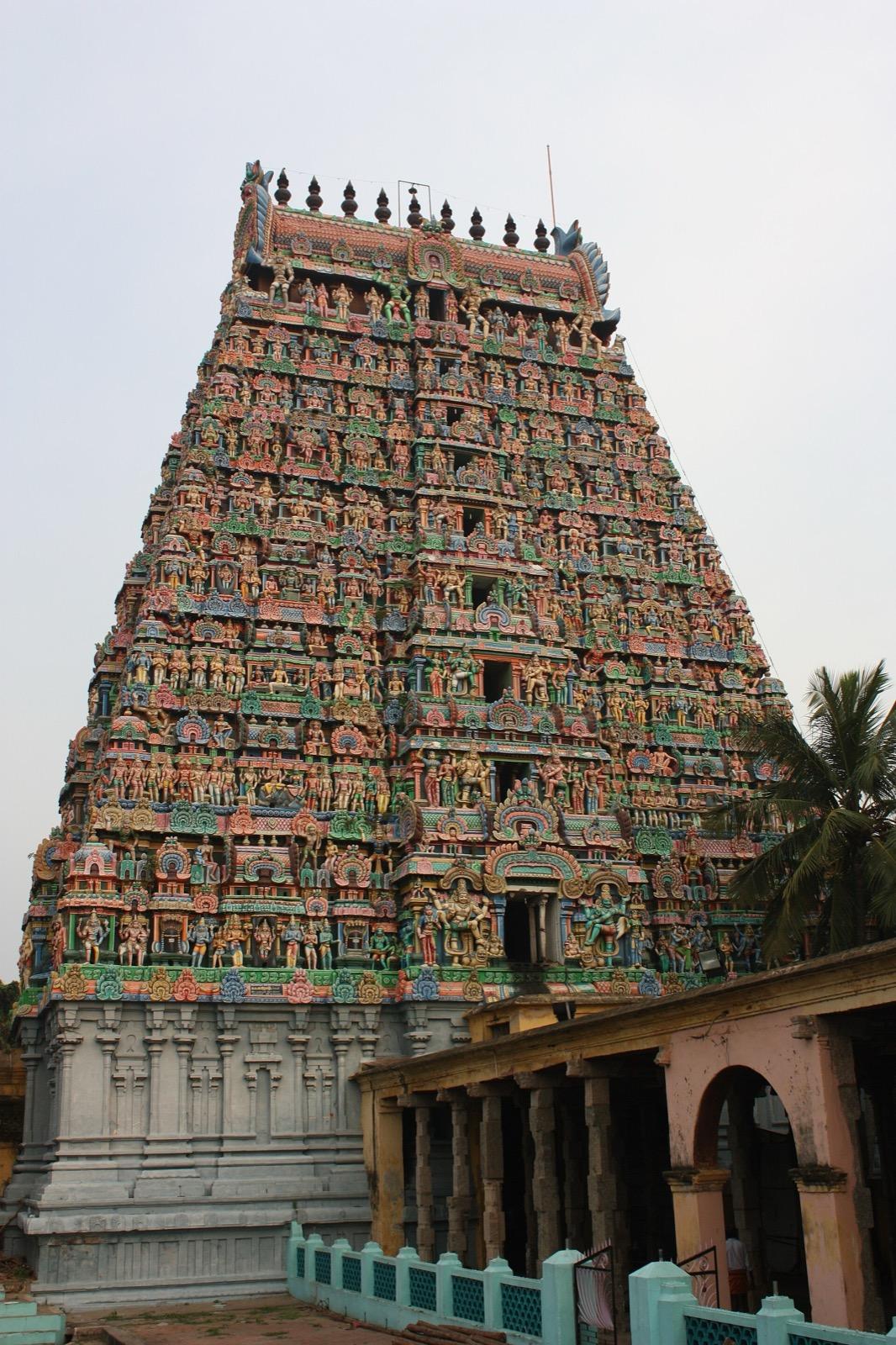
Every twelve years or so, pilgrims crowd the steps of the Mahamaham tank in Kumbakonam to bathe on a single day. The Mahamaham legend explains why: according to tradition, a pot belonging to the god Brahma was carried away by a great flood and came to rest here, and the nectar it held filled the tank. The same story gave the town its name.
Everything below is told as tradition, as the temples tell it. Where temples tell it differently, this guide says which temple holds which version.
The story in brief
According to tradition, Brahma, the creator, kept a pot (kumbha) that held the seed of all life. When a great flood covered the world, the pot was carried away on the waters. It drifted until it reached the place where Kumbakonam now stands.
There, it is said, Shiva struck the pot with an arrow. The pot broke, and its nectar spilled out. The nectar is believed to have fallen into two tanks: the Mahamaham tank and the Potramarai tank. The Mahamaham festival commemorates this story.
The story is kept at Adi Kumbeswarar Temple, the largest Shiva temple in Kumbakonam, at the centre of the town.
Where the arrow was aimed: Banapuriswarar
Banapuriswarar Temple, one of the twelve Shiva temples of Mahamaham, keeps the moment of the arrow. According to its tradition, Shiva took aim from here with his bow at the pot of amrita drifting on the flood. The arrow broke the pot, and the spilled amrita is believed to have filled the sacred Mahamaham tank in Kumbakonam.
The lingam of Adi Kumbeswarar
The town takes its name from the legend of Adi Kumbeswarar Temple. According to tradition, the lingam worshipped here was made by Shiva himself from the nectar mixed with sand. The deity is praised in the 7th-century Tevaram hymns.
The temple dates from the Chola period in the 9th century and was expanded under the Vijayanagara rulers and the Thanjavur Nayaks. Look for its Navaratri Mandapam, where the 27 stars and 12 signs of the zodiac are carved into a single block of stone.
Other temples that keep the story
The legend is not told in one place only. Several temples in and around Kumbakonam keep their own part of it, and their versions differ in the details.
- Gowthameswarar. According to its tradition, when the pot broke, the thread tied around it fell at this place and became the lingam.
- Someswarar. Tradition links this temple, beside Sarangapani Temple, to Brahma's pot, which is said to have come to rest in Kumbakonam after the flood.
- Amirthakalasanathar, Sakkottai. Here the pot is remembered as holding the essence of creation. It is locally called a kalayam, and the place came to be known as Kalayanallur.
- Saranathan, Thirucherai. A Vishnu temple outside the town links itself to the story of creation: Brahma is said to have made, from the sand of this place, the pot that kept the Vedas safe through the flood.
The temples agree on the heart of the story: Brahma's pot, the great flood, and the pot coming to rest at Kumbakonam. What the pot held, and where each part of the story happened, varies from temple to temple.
How Kumbakonam got its name
The name Kumbakonam means roughly "the pot's corner", after the tradition of Brahma's pot (kumbha) coming to rest here. Over the centuries the town has also been called Kudamukku, Kumbam and Baskarakshetram, and British records spelled it Coombaconum. It is also known as Kudanthai.
The nine rivers in the tank
A second tradition gives the festival its power. According to tradition, nine sacred rivers of India gather in the Mahamaham tank on the festival day: the Ganga, Yamuna, Sarasvati, Narmada, Godavari, Krishna, Tungabhadra, Kaveri and Sarayu. A single bath here is therefore held to equal bathing in all of them.
The river goddesses come, it is said, to be cleansed of the sins that bathers have washed into their waters. At Kasi Viswanathar Temple, on the tank's northern bank, tradition holds that the rivers were sent here by Shiva at Varanasi. The temple is often called the Nava Kanniyar temple, after its images of the nine river goddesses worshipping Shiva. On the eastern bank, Abimukeswarar Temple takes its name from the tradition that Shiva turned to face the river goddesses when they came to the tank.
Legend and history
The legend explains what the festival means. Recorded history tells us how long it has been kept.
The Periya Puranam, a 12th-century Tamil classic, records the tradition of the nine river goddesses gathering at the tank to worship Shiva and cleanse their own waters. Carvings of Shiva with the nine rivers can still be seen at the gateway of Kasi Viswanathar Temple. In 1524 the Vijayanagara emperor Krishnadevaraya came to Kumbakonam for the festival and bathed in the tank: his pilgrimage, recorded in inscriptions, is the earliest firm evidence that Mahamaham has been celebrated for more than five centuries.
The next Mahamaham is expected in March 2028 (dates to be confirmed by TN HR&CE). Read more in the history of Kumbakonam and Mahamaham, or meet the temples of Mahamaham.

About the author
Mahamaham 2028 · Kumbakonam
The team behind this independent guide to Mahamaham 2028. Every fact here comes from the sourced pages on this site.
Share this guide
Sources
- Mahamaham (Wikipedia)
- Kumbakonam (Wikipedia)
- Adi Kumbeswarar Temple, Kumbakonam (Wikipedia)
- Banapuriswarar Temple (Wikipedia)
- Someswarar Temple (Wikipedia)
- Gauthameswarar Temple (Wikipedia)
- Amirthakadeswarar Temple (Wikipedia)
- Saranathan Temple (Wikipedia)
- Kasi Viswanathar Temple, Kumbakonam (Wikipedia)
- Abimukeswarar Temple (Wikipedia)
Related pages on this site
Related guides
Temples & culture
Kumbakonam beyond temples: degree coffee, bronze casting and silk
Kumbakonam degree coffee, Swamimalai bronze casting and Thirubuvanam silk: the crafts and tastes of the temple town, and what to look out for.
· 3 min read
Temples & culture
The temples of Mahamaham: a visitor's introduction
An introduction to the 12 Shiva and 5 Vishnu temples connected with Mahamaham in Kumbakonam: what they share and how to plan your visits.
· 5 min read